


What is CPQ?
CPQ stands for Configure, Price, Quote and describes a sequence of processes in sales: product configuration, price calculation and quotation preparation. Particularly when dealing with products that come in many variants or are customised to individual customers, CPQ software helps companies to prepare quotations more quickly, accurately and efficiently.
In this short video, we explain the term “Configure, Price, Quote” in simple terms:
Audio in German. Change the subtitle language by clicking the gear icon in the top-right corner.
What does CPQ mean in sales?
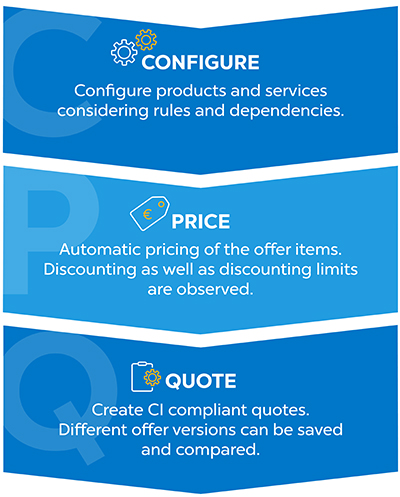
CPQ describes the three key steps in the sales process for products with many variants: configuration, pricing and quotation. The aim is to sell complex products more quickly and without errors.
Configure
In the Configure stage, you assemble products or services from individual elements. You carry out a configuration. CPQ software is a product configurator. This ensures transparency in product modules with multiple variants. It is therefore an indispensable tool for your sales team and your customers.
With a product configurator, you can translate individual customer requirements into concrete solutions with ease. You are then able to convert the individual configuration within the CPQ software into a price calculation and a quotation.

- Guided Selling – guided needs analysis
- Validation check – only options that are truly suitable and functional can be configured.
- Highlighting ‘rule violations’ – if a selection is made that does not work, the software explains why.
- Green Configuration – configure products according to sustainability criteria
- 3D visualisation – watch your product take shape during configuration with the help of 3D visualisation.
- Cross- und Upselling – let the system show you cross-selling and upselling opportunities during configuration
- Online shop and dealer portals – make a product configurator available to your customers too.
Price
You also carry out the pricing within a CPQ solution. The configuration generates a detailed bill of materials for the configured product. This means that a list is generated showing which individual components are included in the configuration. The price is calculated on this basis.
However, fixed prices without discounts are rare these days. An integrated discount function therefore allows your sales staff to add individual special terms. The CPQ system checks whether your sales staff are adhering to their individual discount limits.
In some quotations, the discount may need to be larger than the sales representative’s individual discount limit allows. In such cases, the CPQ software automatically triggers an approval process. This means that a larger discount is possible at any time, but not without the approval of the relevant line manager.

- Discounts – set fixed discount limits. This ensures that every sales representative stays within their limits.
- Approval workflow – the approval process is triggered automatically.
- Engineer-to-Order costing – No more problems when costing bespoke products.
Quote
Once the product has been configured and the price calculation completed, the CPQ solution consolidates all the information. Prices, product descriptions, photos and 3D visualisations are linked and embedded in a clear and consistent layout. This means you’ll have a quotation created in your company’s corporate design in no time at all.

- CI-compliant layout – quotations are created using a standardised layout
- Different quotation versions – does the customer want an alternative to the quotation? Simply save them all.
- Quotation comparison – compare different quotations with one another.
- Multilingual support – generate quotations in different languages.
- Order creation in the ERP or SAP system – thanks to interfaces, you’ll hardly even notice the different systems.
What problems does CPQ solve in sales?
Companies with a wide range of product variants face major challenges in their sales processes: quotations are created manually, product combinations are prone to errors, and pricing is often lacking in transparency.
Typical problems without CPQ:
- long quotation lead times
- incorrect product
- configurations
- inconsistent prices and discounts
- significant coordination effort between sales and technical departments
CPQ software automates these processes and ensures structured, error-free quotation creation.
What is the difference between CPQ and a product configurator?
A product configurator primarily maps out the technical logic of a product and assists with the selection of variants. CPQ goes one step further by also integrating price calculation, taking into account discounts and pricing rules, and automatically generating complete quotations.
CPQ thus combines product logic, pricing and sales processes within a single system.
What is a CPQ system?
The abbreviation CPQ stands for Configure Price Quote. This refers to software solutions that support sales staff in preparing quotations. The system guides you safely and quickly through all the stages of product configuration, pricing and quote generation. CPQ integration in webshops allows customers and dealers to configure their individual solutions themselves with ease. In this way, companies additionally open up new channels for lead generation.
The process of preparing a quotation is accelerated, simplified and optimised. The CPQ system represents the link between all the stakeholders (customers, sales and production).
Why is CPQ becoming increasingly important?
The market for CPQ software has been growing strongly for years. This is due to the increasing complexity of product portfolios, the digitalisation of sales processes and the desire for faster, error-free quotations. Recent market analyses of the CPQ sector also forecast significant growth in the CPQ market for the coming years.
For which companies is CPQ suitable?
CPQ is frequently used by companies that sell products with a wide range of variants – in other words, products that are specifically combined from various individual components. These include, for example, plant and machinery manufacturers, component manufacturers, devices and apparatus manufacturers, as well as manufacturers of building products and medical technology. In our case studies, you will find many companies that are already using CPQ.
The demand for increasingly customised products is leading to a growing number of variants. To manage this variety, products are modularised. This makes it possible to significantly reduce the number of variants internally and keep them under control. At the same time, you can still fulfil your customers’ individual requirements. This creates a modular variant system. You can combine these standardised modules to create product variants tailored to individual customers. This is the basis of CPQ.
What are the advantages of CPQ?
If you opt for a CPQ solution, you will benefit from numerous advantages, including the following:
- You will accelerate your entire sales process.
- There are no errors in the configuration and the quotation, because the system knows all the rules and dependencies.
- Product knowledge is no longer held by individuals, but in the system. Among other things, this makes it faster and easier for new members of the sales team to get started.
- You will reduce your costs, because your employees are relieved of a great deal of work by the software. In this way you accelerate the process chain and work more efficiently.
- The CPQ system can automatically alert you to cross-selling and upselling opportunities.
- Not only your sales staff, but also dealers and your customers themselves, can assemble products independently.
- Data silos? Not with CPQ. The various interfaces ensure better interaction and thus a lower error rate.
- You get to know the wishes and needs of your target group better. With CPQ you can evaluate which configurations are made most frequently.
- You retain your customers. You will also increase your turnover, thanks to better customer retention and more effective work in your company. Plus, you’re already giving your customers the opportunity to learn about your products on their own. This increases customer loyalty.
- You will also increase your turnover, through better customer retention and more effective work in your business.
Recent market analyses also highlight the economic importance of modern CPQ solutions. A study cited by Nucleus Research concludes that outdated CPQ systems can cost companies potential revenue because sales processes become slower and less efficient.
What are the disadvantages of a CPQ solution?
A CPQ solution does not really have any disadvantages. However, there may be a few challenges:
- Implementing CPQ software can be costly. It always depends entirely on the product portfolio and the desired depth of integration of the software. After the introduction of the solution, however, it quickly becomes clear: it is well worth the effort! With the right partner at your side, you will receive active support even during your preliminary considerations for a CPQ project. This reduces the effort required for implementation to a minimum.
- People are creatures of habit. This is also noticeable when processes in the workflow are changed. This is why some employees may be a little reluctant to use the new tool at first. However, as soon as they have got used to working with the software, your staff will not want to be without it.
Do you want to find out more about CPQ and the benefits of the software? Then take a look at our eBook “7 good reasons for Configure Price Quote (CPQ)”.

When should you use CPQ?
Are you wondering if it is time for you to implement CPQ in your organisation? There are several signs that it’s time for CPQ software. Take the test yourself. If two or more statements apply to your company, CPQ is the right answer to your challenges:
You can find the downloadable checklist in this eBook.
CPQ: Three compelling arguments
- More reliable
The sales department maintains an overview of the entire range of solutions. All the relevant data and rules are stored and maintained centrally – so there is no risk of anyone working on the basis of outdated or incorrect information. The system automatically excludes any erroneous configurations. - Faster
Thanks to far-reaching automation of processes, the speed of quotation preparation increases significantly. Processes that used to require a lot of time and the involvement of numerous employees from different areas of the company are shortened to an absolute minimum. - More profitable
The high transparency of the data and rules prevents discount limits from being exceeded and thus leads to higher company revenues. Additional sales are easier to achieve because the system actively points out cross-selling and upselling opportunities.
Do you want to stay up to date on the topic of CPQ? Then watch our webinar with Feintool to see the role encoway CPQ Sales has played on the road to digital sales. Or have you already decided to implement a CPQ solution in your company? Then the next step should be to create a specification sheet. You can find out what you should look out for in our checklist.
Do you need a CPQ solution? Then test now whether you are ready for the introduction of CPQ software:

Conclusion: What is CPQ?
CPQ (Configure, Price, Quote) describes an end-to-end process for configuration, pricing and quotation. Particularly for complex products with a wide range of variants, CPQ helps to structure sales processes, reduce errors and create quotations efficiently. This makes CPQ a key component of modern sales processes in many B2B sectors.
Frequently Asked Questions about CPQ (Configure, Price, Quote)
What does CPQ stand for?
CPQ stands for Configure, Price, Quote and describes a sequence of processes in sales: configuring a product, calculating the price and creating a quotation. CPQ software provides digital support for these steps and helps to create quotations more efficiently and consistently for products with a wide range of variants.
How does CPQ software work in practice?
CPQ software guides users through the Configure, Price, Quote stages: first, the product is put together using rule-based logic; then the price, including terms and conditions and discounts, is calculated; and finally, a quotation is generated. Typical functions include, for example, guided selling, validity checks and, optionally, 2D/3D visualisation.
When is CPQ worthwhile?
CPQ is particularly worthwhile when it takes too long to produce quotations, errors occur due to manual configuration, or pricing logic and discounts are difficult to maintain consistently. A good indicator is when the sales and technical teams regularly have to clarify queries before a quotation is finalised.
For which companies is CPQ particularly suitable?
CPQ is suitable for companies with a wide variety of technically complex products – for example, in mechanical and plant engineering, component and equipment manufacturing, or in the construction products and systems sector. CPQ really comes into its own wherever there are numerous options, rules and interdependencies.
What is the difference between CPQ and a product configurator?
A product configurator primarily supports the selection and validation of variants (Configure). CPQ goes a step further and also integrates pricing (Price) and quotation generation (Quote) into a seamless sales process.
Which systems can I integrate with CPQ (e.g. CRM/ERP)?
CPQ systems are often linked to or integrated with CRM and, depending on the architecture, can also be connected to ERP and e-commerce/portal environments to ensure data and processes remain consistent. It is crucial that product, pricing and quotation logic do not become fragmented across siloed solutions.
Further information on CPQ

Teamleiter Marketing, encoway GmbH
LinkedIn
Lars Schade is Head of Marketing at encoway in Bremen and is responsible for the strategic positioning and communication of the company’s software solutions. Through close collaboration with product development, sales and customer projects, he has in-depth practical knowledge of CPQ, product configuration and the digitalisation of sales processes in the B2B sector. With over ten years’ experience in technical marketing, his articles provide practical insights, trends and specific recommendations for manufacturers of complex products.